
Hi 👋 I’m a Ph.D. candidate in the Learning Sciences program in the Department of Educational Psychology at the University of Wisconsin–Madison, advised by Professor David Williamson Shaffer in the Epistemic Analytics Lab, part of the Center for Research on Complex Thinking. I do research at the intersection of learning sciences, statistics, and data visualization.
Prior to this, I worked as a Learning Experience Designer for Accessibility at the Center for Academic Innovation at the University of Michigan–Ann Arbor, under the mentorship of Professor Rebecca Quintana, where I worked on online course design and learning analytics research.
I hold an M.A. in Educational Studies from the University of Michigan–Ann Arbor (advised by Professor Chris Quintana) and a B.S. in Information Management Systems from Tianjin University of Technology in China.
My Research
I develop methods! Specifically, I develop computational methods for educational research, with a focus on modeling learning processes. I believe good methods are theoretically grounded, computationally rigorous, and visually expressive. Here are some highlights:

Ordered Network Analysis (ONA), my first signature method, has been employed in 100+ published works across quantitative ethnography, learning analytics, AI in education, healthcare, and policy analysis since its inception. ONA was recognized as Best Student Paper at the 2022 International Conference on Quantitative Ethnography.

Epistemic Trajectory Modeling (ETM), my current ongoing project, extends ONA to model learning trajectories. Rather than summarizing learning as a static network, ETM traces the underlying mechanisms that drive behavior change over time to characterize learning as a dynamic process. Try my prototype app here! (link coming soon)
Additionally, I investigate adjacent topics that inform my method development work:
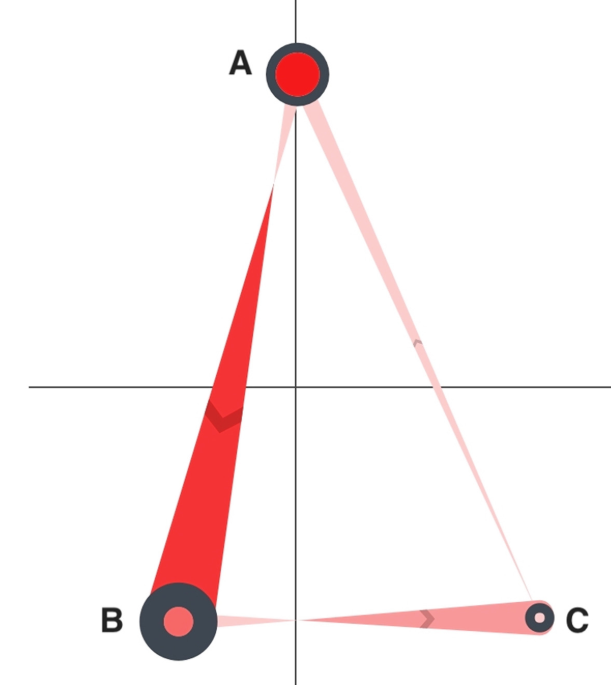
Network visualization. I believe the alignment between numerical and visual representations shapes how people interpret results. I’ve written about the layout algorithm behind ONA networks and ENA’s graphic design, with a focus on supporting faithful and intuitive reading of network analysis results.

Simulations. How to measure learning in open-ended environments where there’s no single right answer? In this work, ONA was applied to visualize player trajectories in an urban planning game iPlan by constructing a simulated normative model of expert behavior against which player activity can be projected and compared.